The quintessential search for a method of demonstrating the effectiveness of training has been going on for a long time.
The one fear we trainers have is: What if someone turns around and asks, “We are spending such a large amount on training, is it providing any value at all? This is hard earned money you know”.
Without any clear system to demonstrate the value addition by training, anybody can rip it apart.
Any practitioner can say, “This is all theory. It is good for discussion sake. On the ground, it won’t work.”
We need to have data to support our claim of the value of training.
An even more important aspect of this is that we need the proof for our own sake. After continuously exhorting the benefits of training for a long period, there does remain a nagging doubt in the corner of the heart. “Is it really so? Am I really adding value”?
I also see that without any data to backup our claims, we become dependent on practitioners to put their stamps of approval on our approach.
This dependence is disturbing to say the least.
Just sharing with you an incident that I observed. A trainer was conducting an outdoor program with a sales team. In the analysis of the team’s performance, the alternative strategies that the team could have adopted were being discussed. The trainer was emphasizing the need for exploring alternatives strategies, while the participants were adamant that the strategy adopted by the team was excellent. Finally, it was up to the team leader to take a decision, whether to agree to the trainer or the team members.
One of the team members said to the Team leader, “It is for you, either to accept the assertion of the trainer or hit for a six”.
When something like this happens, the trainer is left feeling small.
On the other hand, if the trainer had demonstrable proof of his assertion, it would be easier to accept and more difficult to blow his perspective away.
As of now, the predominant quality check of the potency of the training program or the trainer is the nod of the line manager.
What if the Line manager is ignorant or has a faulty or incorrect perception?
Citing the experience of a trainer in this regard. This trainer conducted a program for an IT company. He got excellent feedback from the participants after the program.
Subsequently, he was told that there should have been more humor in the program. Hence, the trainer was changed.
Though humor does tend to add liveliness to a workshop, the effectiveness of the workshop can not be decided on only this parameter.
We are missing the wood for the trees.
What about the level of competence development achieved?
What about the level of learning achieved?
What about the level of application catalyzed?
These parameters are any day more relevant and vital to the effectiveness of a training program rather than the predominance given to humor.
There needs to be some other “proof of quality” other than only the nod of the line manager.
In the current state of affairs, trainers are at the mercy of the line managers, for an approval rating.
Thus, it is to our benefit that we deploy a system for collecting data regarding the effectiveness of training; we need to resist the tendency to do large number of programs without any assessment of impact. The more programs we do in this manner, the more blanks we keep open for an attachment regarding our credibility.
In order to get out of this chakravyuh, trainers need to deploy a system for assessing training effectiveness. Most of the systems available in the public domain such as the Kirkpatrick’s model are easy to understand conceptually, but difficult to implement. In the Kirkpatrick’s model, Level 3 and Level 4 assessment are difficult to implement.
For the training assessment process to be potent, it should mirror the competence development process. In fact, in addition to assessment, its function should be to catalyze competence development.
In order to evolve the assessment process, we need to first answer the question, “What should be assessed?”
The obvious answer is that we should assess the level of learning, the level of competence development, the level of competence application and the resultant success/failure.
This leads us to competence development process.

The critical stages in the competence development process are those of “Assimilation of Learning”, “Application” and “Analysis/Synthesis of success/failure”.
These are the stages, where we should be assessing the effectiveness of the training program.
The training assessment process should mirror the competence development process.
This leads us to a “Model for evaluating training effectiveness”. It has 3 levels:
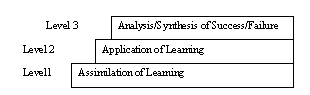
Model for Evaluating Training Effectiveness
For level 1 assessment, the deployment of pre and post tests is an effective instrument.
However, the questions in the pre and post test need to be aligned to the competencies that we want to develop in the program.
In case, competencies have not been identified, the entire competence development and assessment process would fall flat.
Thus, competencies that need to be developed have to be identified and integrated into the design of the program.
The pre and post test data gives us an assessment of the level of “Assimilation of learning”.
In some organizations, I have noticed a resistance to the Pre test with the unsaid notion, “We have not learnt anything yet, so, what are we being assessed for?”
The pretest not only gives us valuable data regarding the level of participant learning at the commencement of the Competence development process, it also creates our openness to learning regarding the competencies that are examined during the program. The participant perceives a gap in learning and thus the search behavior for solutions is triggered. Consequently, the blocks to learning decline.
For “Level 2 assessment”, there is a need for a tool which triggers application of learning.
The formulation of a GANTT chart for mapping the application of learning is useful for this purpose. This map can subsequently be utilized by the trainer to assess the level of application of competencies examined during the workshop.
Only a select few organizations have adopted this approach. The impact is visible in terms of the “Competence development” achieved.
The data collected during the level 2 assessment exercise is “gold” for the trainer. It indicates the Return on investment in terms of competencies learnt and applied and the subsequent successes achieved. This data enhances the power of the trainer to demonstrate the visible impact created or the visible value added. Then nobody can come along and question the raison d’etre of the trainer’s existence.
For implementing this model, the mount of effort to be put in by the trainers increases multifold. It is worth it and if we want to be change catalysts, there is no escape from it.
Back