When the organization is in trouble, the training budget is the first one to get hit. Rather than grumbling about it, we as HR professionals need to examine, why?
There is an extremely strong possibility that training is viewed as a nice to do thing rather than a truly value adding or value creating activity. If it was a value creating activity or a performance enhancing activity, there would automatically be more focus on it when the demand is falling, margins are slumping and competition is increasing.
Most of the time, the training process adopted follows a distinct pattern:
Dominant Training process adopted
This is the Dominant mental pattern of training whether the times are good, bad or ugly.
Doesn’t this seem strange? Whatever the situation, the training strategy cum process remains the same.
Another blind spot of this omnipresent training process is the gap of a training strategy. If we don’t know where to go, we will obviously keep on sitting at the same place. If we don’t have a direction, we would invariably flounder around. Inspite of this logic being obvious, HR departments still do not have training strategies.
The training strategy can not be conceptualized until the training incharge has a feel for the business and the organization processes involved. A lack of this assimilation results in the training department and the rest of the organization functioning on different planes.They are incomprehensible to each other.
For long, we have been talking about the need of HR acting as a business partner and for long we have seen the HR department functioning inside an ivory tower unaffected by organizational ups and downs.
Therefore, it is no surprise that the training budget is the first to be axed when the organization is facing rough weather.
The training strategy would vary according to the situation that the organization is facing.
The training strategy of an organization in troubled times should have a direct impact on organization performance. It should focus on the organization needs is-a vis the market scenarios, competitors and technology.
Since most of the the organizations are in troubled waters nowadays, lets evolve a training strategy which triggers organization performance,when the going is tough.
The key objective of an organization during such a situation is increase in sales along with maintenance of margins.How can training contribute to this?Let’s examine.
An increase in sales can only be brought about if we either increase consumption by current customers or increase customers or increase products / services or develop better service / product quality.
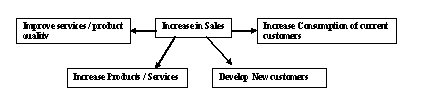
The training strategy should be designed to achieve these 4 sub-objectives.
Training Strategy in troubled times:
Focus 1: Front Line Departments ::
For increasing consumption and for developing new customers, the training strategy components for the frontline departments are:
An intervention is required for enhancing the performance of front-line departments.
The focus areas :
For example for FMCG companies,this intervention can be targeted at setting KRA’s for and generating sales process innovations in supermarkets ,bazaar presence,inshop visibility and dealer motivation. This would enable the organization to break new ground and also be a moving target for its competitors.
The competencies of personnel running the front-line departments need to be at the cutting edge in the area of Customer Interface Management.
The competencies that need to be nurtured are:
a. Product and organizational Positioning: Creating an identity for the organization and its products in the mind of the customer. Product differentiation from competing products is vital for impacting consumption and attracting new customers.
Positioning the organization product vis – a -vis key customer benefits is the key to the customer’s mind. The formulation of positioning statements w.r.t every organizational product and the practicing of their delivery is necessary for the development of the positioning competency.
b. Influencing :
Creating the desired mental pattern through the presentation of relevant data with respect to the efficacy and relevance of the product/ service.The data as well as the way it is presented creates the desired customer opinion and instinct.
The question may arize as to which departments are frontline departments .The front –line departments would be Regional Sales offices for FMCG or service oriented companies and account management departments for organizations focussed on industrial marketing.
Focus 2: R & D department:
The objective of training the R & D personnel is not only to catalyze the generation of new products and services but also to reduce the time to market of such products and services.
Therefore, the training agenda would involve the assimilation of new Innovation Tools and processes as well as their live applications for generating innovative products and processes.
Focus 3:Organization Processes:
Product / service quality is directly dependent upon the efficiency of organization processes.
Therefore the agenda for training is key process modeling and benchmarking.
The roll out of the training strategy in these focus areas would immediately start having an impact on performance.
In case the training department develops and implements such as strategy , its value would be visible in terms of Increase in sales , new products developed and improved quality of organization processes.
Consequently, the training budget and the role of the training department is bound to increase rather than decrease in troubled times.
After this discussion,if we relook at the dominant training process mapped at the beginning of the article,its inadequacy screams at us.
Back