One of the major endeavors in the area of organization development has been that of,”Team Building”. It has been one of the stated objectives of most training departments. Everyone has realized the importance of teams and their criticality of success. Everyone talks about it. However, the question of “How to go about it” remains fuzzy and unanswered.
Precious little has been done in this area except experiments in outbound training and workshops.
There have been cases of organizations believing in,” Team Building” and thus investing loads of money and effort without achieving anything significant. This has also resulted in disillusion regarding Team Building. This is reflected in the words of a training manager, “Team Building is a bad word in our organizations. Lots of effort has been put in. Nothing has been achieved.”
Synergy is not easy to achieve. The challenge has been underestimated. Putting a team through an outbound training program and expecting a change in the team's functioning is expecting too much.
The value add of outbound training per se, has been lost in the “Great experience” clamor that follows any such event.
Let's analyze a few such events:
A leading IT organization realized the potency of outbound training and decided to send one of its key project teams on one such exercise. The project team went through multiple exercises in a semi forest area. Each exercise was followed by a review in which the key learning points got evolved.
The program feedback was good. However, after 2 months, when a reality check was done regarding the change in the functioning and performance of the team, the result was enervating. Not a single change in the functioning and performance of the team had happened.
Something amiss here. What is being missed out? The program feedback was good but the program effectiveness is poor. This also tells us a lot about our systems of assessing training effectiveness. It also brings to the fore the inadequacy of Quality systems deployed in organizations.
In one such organization, the quality process necessitated the filling up of the training feedback form, identifying errors and rectifying them through further input or program redesign. An OD Intervention was initiated in the organization. The trainer, following the dominant systems immediately deployed the program feedback form. The system was supposed to be deployed for training programs and not for OD interventions. However, the lack of a system to assess an OD Intervention, resulted in the organization deploying a training assessment system in order to assess OD effectiveness.
The result was an inability to assess the results in the context of OD, culminating in the death of OD intervention.
The existence of a training assessment system does not mean that it should be applied in all developmental initiatives.
Though Kirkpatrick's model of training assessment has caught the imagination of a lot of trainers, the assessment of training continues to be at program feedback level, which is level 1 assessment. That is woefully inadequate.
As far as OD is concerned, an entirely new system for assessing OD effectiveness is required. In fact the entire system of OD starting from OD needs identification, to designing OD interventions to deploying them and subsequently assessing their effectiveness has to be designed anew.
The current processes of identifying training needs are definitely not going to throw up the OD requirements of the organization.
The training paradigm is so strong that it is blinding the training departments regarding OD opportunities. The absence of defined OD systems in the organization results in no action in the area.
A key team in a leading organization was having effectiveness problems because of entrenched hierarchical thinking, no lateral communication was occurring and thus Collaboration across the prevalent hierarchies was non existent. Realizing the gap in team effectiveness, the leader of the team initiated an OD intervention focused on enhancing team functioning and performance.
This was initiated by the leader of a functional team. This highlights the absence of a process to identify an OD need pro-actively. In this case, the team leader was assertive and confident enough to unleash such an exercise. However, in most of the cases, such OD requirements would go unnoticed.
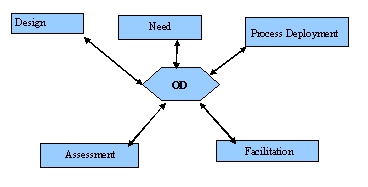
OD is a different ball game and thus requires a different mindset from training.
Most of these out bound training programs targeted at functional teams would remain ineffective, if conducted as isolated events. On the other hand if they are a component of a larger OD plan targeted at enhancing team functioning and effectiveness, there is a glimmer of “possibility”.
The potency of this approach is highlighted by the experience of a leading service oriented organization. The out bound training program was designed as the first component of an OD exercise that spanned over 3 months.
In addition to fun and games for unfreezing interpersonal perception within the team and identifying competencies to be deployed for team building, the OBT triggered “preliminary” diagnosis of team issues. OBT was evenly designed between off line and on line team building activities in which work place data was utilized.
Thus, in spite of the hype of an outbound, there was clear anchoring of the program in the ground realities of the workplace.
The program was followed up by a detailed diagnostic exercise and team action planning. Adopting such an OD approach creates a feeling of relevance.
This is aptly demonstrated by the statement of a participant of one such program, “I definitely liked to be scratched by branches in the outbound session but I actively want these team problems resolved”.
Back